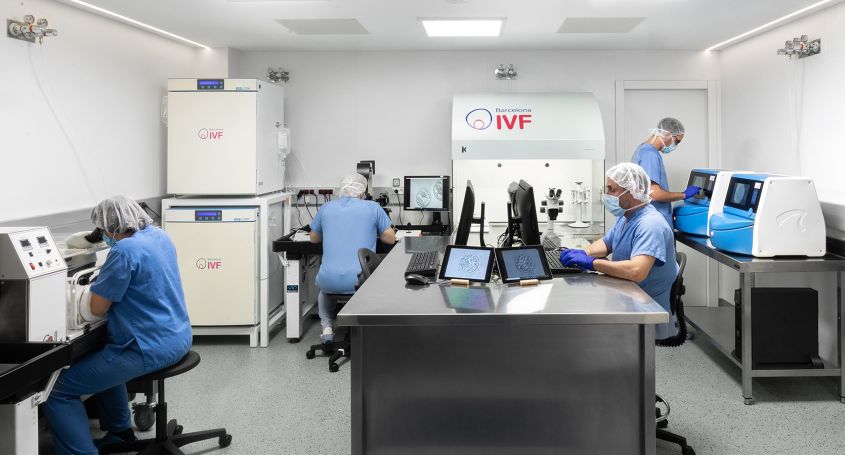
When choosing a fertility clinic, it is common to focus on aspects such as success rates, the experience of the medical team or reviews from other patients. However, there is one element that often goes unnoticed, but has a direct impact on outcomes: the in vitro fertilisation (IVF) laboratory.
The IVF laboratory is where some of the most delicate biological processes of the treatment take place. For this reason, its technology, conditions and the experience of the team working in it are key factors in the success of the treatment.
The IVF laboratory: where the essential processes take place
Many critical stages of IVF treatment take place inside the laboratory, such as:
This means that the environment must be as stable, controlled and safe as possible.
Reproducing the embryo's natural environment
One of the main objectives of an IVF laboratory is to reproduce, as closely as possible, the conditions of the embryo's natural environment. To achieve this, variables such as the following are strictly controlled:
- Temperature
- Gas levels (CO2 and O2)
- Humidity
- Air quality
At Barcelona IVF, we have advanced control systems that allow these conditions to be kept stable, reducing to a minimum any alteration that could affect embryo development.
Advanced technology to improve embryo selection
The incorporation of the most advanced technology is one of the pillars of the Barcelona IVF laboratory.
Among the main tools we use are:
- Continuous embryo development monitoring systems (time-lapse).
- Techniques that optimise each stage of the process, such as:
- Intracytoplasmic sperm injection (ICSI)
- Advanced sperm selection techniques
- Blastocyst culture
- Artificial intelligence-based tools that support the selection of embryos with the highest implantation potential.
These technologies make it possible to take more precise decisions and improve control over each stage of the process.
Integration of the laboratory within the clinic: greater control and precision
Another important aspect is the integration of the laboratory within the clinic itself. Having an in-house laboratory allows for:
- Greater traceability of samples
- Better coordination between the different specialists
- Shorter procedure times
In addition, our quality and safety standards are endorsed by ISO 9001 and UNE 179007 accreditations. All of this translates into greater control of the process and more agile and precise care for the patient.
Commitment to innovation and excellence
Assisted reproduction is a constantly evolving field. At Barcelona IVF, we are committed to incorporating innovative technologies and continuously updating our laboratory protocols, with the aim of improving the quality of processes and optimising results.
This philosophy has led us to be pioneers in the application of certain techniques and to maintain an approach based on precision, innovation and excellence.