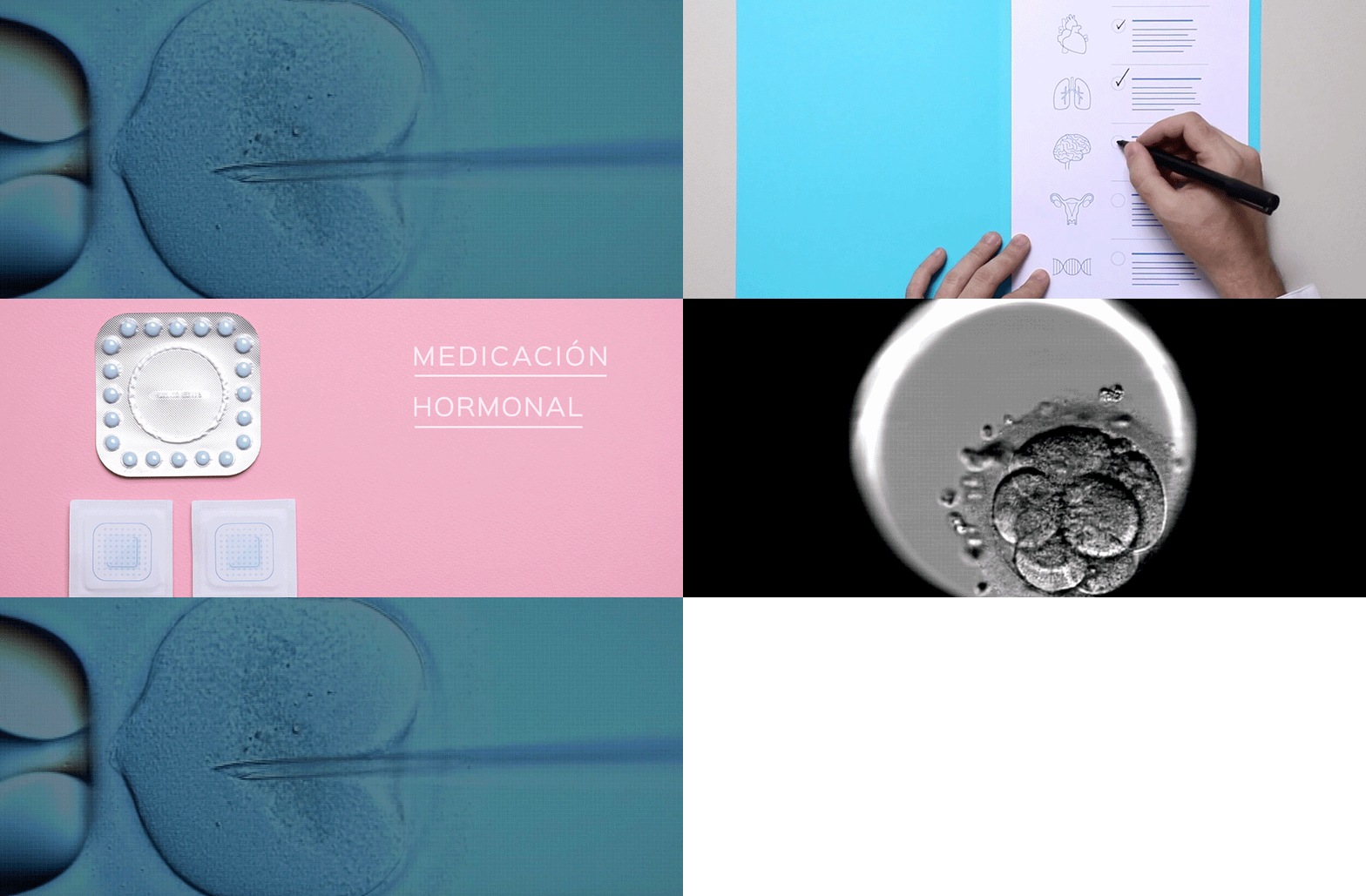
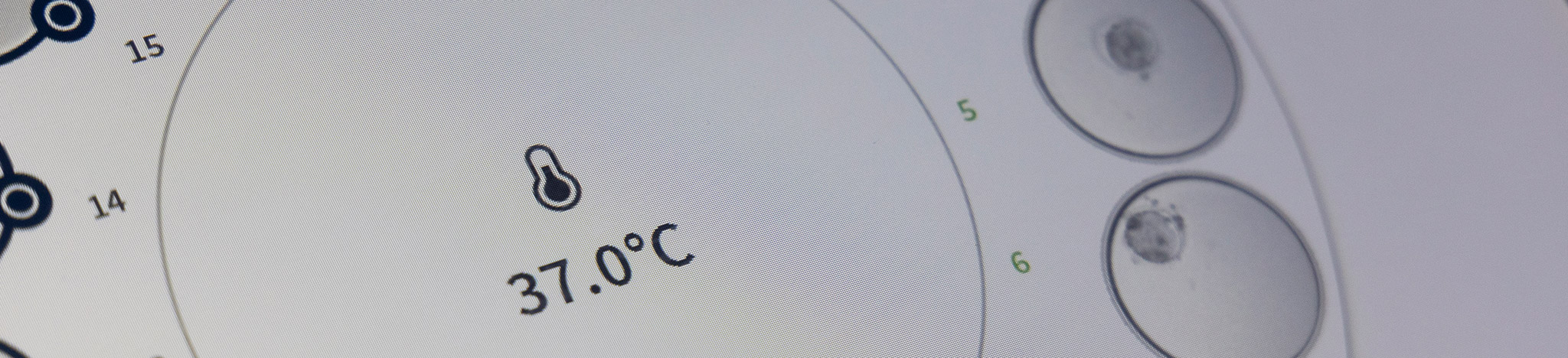
Egg donation is the assisted reproduction treatment where eggs from a donor are fertilised with the sperm from the partner or a donor, in a laboratory.
Egg donation is recommended in cases where the woman cannot achieve a pregnancy with her own eggs. The most common causes are:
Advanced age
Low egg quality
Low ovarian reserve after repeated In Vitro fertilisation failures
Genetic disorders
Which previous tests are necessary?
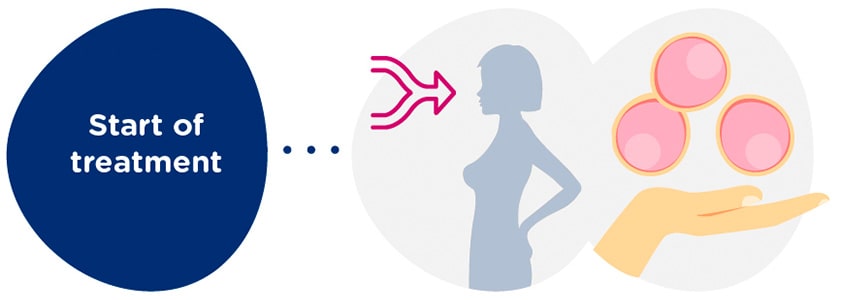
Performing egg donation requires a series of additional tests:
Gynaecological ultrasound to rule out uterine and ovarian diseases.
Semen analysis to evaluate the quality of the sample. If sperm quality is very low, it will be necessary to extend the andrological examination with other additional tests.
Male karyotype to rule out genetic abnormalities which may affect the embryo.
Serologic test to rule out the presence of transmissible infectious diseases.
Can I resume normal life after egg donation?
You can resume normal life throughout the process until the embryo transfer. On this particular day, it is recommended to comparatively rest and, from then on, you should lead a quiet life avoiding significant strain, the same as if you were trying to become pregnant naturally.
There is no problem with travelling after embryo transfer.
How often can a donation be performed and what is the attempt limit?
There is no limit to the number of egg donations that can be performed but it must be acknowledged that 90% of the patients achieve a pregnancy within 3 egg donation cycles.
Unlike In Vitro fertilisation, there is no need to wait to perform another cycle with egg donation, since the uterus is ready to receive embryos again after the period. It is convenient to re-evaluate the case after each cycle which did not achieve a pregnancy, in order to determine whether more tests are necessary.
What are the possible risks linked to the treatment?
The main risk of egg donation is a multiple pregnancy if more than one embryo is transferred. Along with the very good results from the long blastocyst culture, many couples currently decide to transfer a single embryo to avoid a twin pregnancy.
Gynaecological tests
How often do I have to go to the clinic during the treatment?
You will have to go to the clinic twice to perform the treatment. The first time to organize the cycle and to freeze a sperm sample if necessary. The second time to perform the embryo transfer.
During the process, an endometrial ultrasound scan will be performed that can take places at the Clinic or with your usual gynaecologist.
Donor selection
Who are the egg donors?
Egg donors are young women aged between 18 and 35, and in good physical and mental health. They will have to pass a series of tests to become a donor, which include examining their personal and family medical history, a psychological evaluation, general and gynaecological examinations, a blood test to rule out possible infectious diseases and necessary genetic testing.
All our female egg donors must have undergone the strictest selection tests to determine their eligibility as donor.
How can we improve donor selection?
With the aim of offering the highest quality treatments, Barcelona IVF subjects its donors a carrier genetic test to reduce the risk of some severe hereditary diseases.
Once the donor has been selected, we can evaluate the risk of whether the child will have any of these diseases. To that end, the father needs to undergo the carrier genetic test as well. In the event an increased risk is detected, a different, compatible donor will be sought out in whom the risk is low.
How is my egg donor chosen for In Vitro fertilisation?
Egg donor assignment is performed by our specialized medical team, based on the patients’ physical characteristics and their blood groups. This is a task of tremendous responsibility, therefore our team performs each donor assignment considering the individuality of each case.
What information can I have about the egg donor?
In Spain, egg donation is anonymous which protects the identities of both the donor and the patients and their offspring. Nevertheless, it is possible to learn general information about the donor, such as her physical characteristics, blood group and age.
At Barcelona IVF, we also share details on the donor related to her hobbies, personality and the reason why she decided to donate, so that you have all the information available on the donor, always in compliance with the Law and respecting the privacy of all parties involved.
Synchronisation
Why is synchronisation with the donor necessary?
In order for egg donation to be performed, the donor and the patient need to start their cycle at the same time, to ensure that the patient’s uterus is prepared when the embryos are transferred.
This stage lasts for approximately 2 to 3 weeks and is very important in order to have the highest chances of success in the treatment.
Endometrial preparation
What is the endometrium?
The endometrium is the tissue that lines the inside of the uterus, the organ within which pregnancy takes place. To achieve a pregnancy, the endometrium must be prepared to receive the embryos for them to implant correctly.
How do I prepare my endometrium for egg donation?
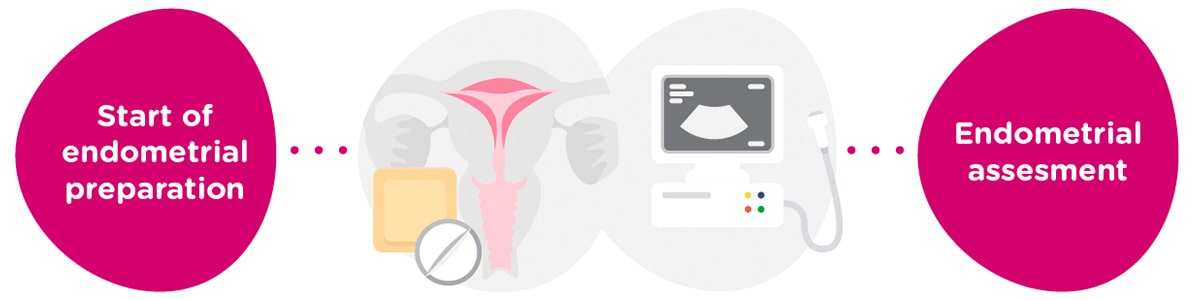
The endometrium is prepared to receive embryos through alternate hormone therapy that imitates the woman’s natural cycle.
We start with oestrogen, checking the endometrial development with a vaginal ultrasound.
Once the eggs are collected from the donor, progesterone will be added to the therapy so that the endometrium is receptive on the day of the embryo transfer and to maximise the chances for pregnancy.
Embryo collection and transfer
How are the embryos collected?
The embryos are collected by performing In Vitro fertilisation on the donor’s eggs with the partner’s sperm or sperm donor. These embryos are maintained in culture in the laboratory for 5 days until they reach the blastocyst stage.
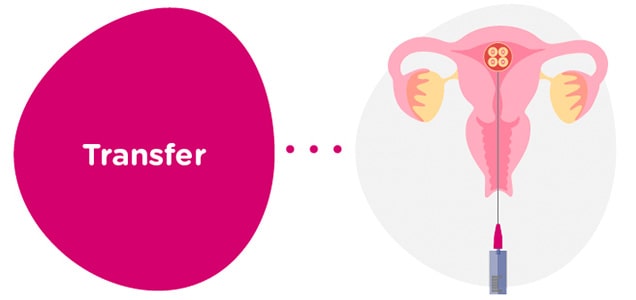
How are the embryos transferred?
Embryo transfer is a simple procedure which does not require a hospital admission or anaesthesia. A catheter is inserted into the cervical canal to place the embryos inside the uterus. Usually 1-2 embryos are transferred, although the current trend is to transfer a single embryo in order to reduce the risk of a twin pregnancy.
What happens to the embryos that are not transferred?
If there are still some good quality embryos after embryo transfer, they will be frozen.
Can I do something to improve my chances for pregnancy after the transfer?
It is very common to wonder what you can do after the transfer to encourage a pregnancy. There is nothing else you can do to increase the chances for a pregnancy, apart from waiting for the embryos to implant correctly and resume a normal and relaxed lifestyle.
Egg donation at Barcelona IVF
Why perform an egg donation treatment at Barcelona IVF?
At Barcelona IVF, we guarantee you:
The highest quality in selecting our donors: we apply the strictest selection tests to ensure the greatest safety in this process.
Best results: at Barcelona IVF, we guarantee that the recipient will receive at least 8 mature eggs from the donor. Along with the embryo blastocyst culture, this allows us to achieve the best results.
Genetics Matching with the egg donor: it allows us to reduce the risk that the unborn child will suffer from more than 250 known genetic diseases.
Real reviews from our patients
★★★★★4.5 · 573 reviews on Google
★★★★★
Dr. Olivares and his team made a dream come true: the birth of Gabriele. Thanks to egg donation, we became parents. Thank you for your professionalism, availability, and the love you've shown us over these months.
Translated from original: Italian
Dr. Olivares and his team made a dream come true: the birth of Gabriele. Thanks to egg donation, we became parents. Thank you for your professionalism, availability, and the love you've shown us over these months.
Il dott. Olivares e la sua equipe hanno reso possibile la realizzazione di un desiderio: l’arrivo di Gabriele. Grazie alla tecnica dell’ovodonazione siamo diventati genitori. Grazie per la professionalità, la disponibilità, l’affetto dimostrato in questi mesi.
★★★★★
A very professional and empathetic team. I can highly recommend them. My egg donation was successful on the first try and I gave birth to a wonderful daughter.
Translated from original: German
A very professional and empathetic team. I can highly recommend them. My egg donation was successful on the first try and I gave birth to a wonderful daughter.
Sehr professionelles und empathisches Team. Kann sie nur wärmstens weiter empfehlen. Bei mir hat die Eizellenspende beim ersten mal geklappt und habe eine wundervolle Tochter geboren.
★★★★★
Fantastic clinic! Thank you to Dr. Sera and our contacts Samantha and Silvia for their work, attentiveness, and availability. They helped us realize our dream of having a child. Despite the difficulties, we always kept…
Read full reviewTranslated from original: French
Fantastic clinic! Thank you to Dr. Sera and our contacts Samantha and Silvia for their work, attentiveness, and availability. They helped us realize our dream of having a child. Despite the difficulties, we always kept hoping, and they gave us the strength to believe. I also highly recommend this clinic for their professionalism. They take an interest in each case and find tailored solutions, despite the work involved. They offer contracts adapted to each client's budget, which is rare for clinics in Spain, and provide solutions in case of financial difficulties. The clinic is responsive and efficient; the waiting times for finding a donor, for example, are reasonable. The clinic adapts to our wishes and always supports us fairly. If I weren't 44, I would do it all again without hesitation and would trust Dr. Sera and his team once more.
Super clinique ! Pour leur travail, écoute et disponibilités Merci au Dr Sera et à nos correspondantes Samantha et Silvia Ils nous ont permis de réaliser notre rêve… avoir un enfant … malgré les difficultés toujours continuer d’espérer , ils nous ont donné la force d’y croire Je recommande également cette clinique pour leur professionnalisme car ils s’intéresse à chaque cas et trouveront des solutions adaptées malgré le travail qu’il faudra fournir Ont des contrats adaptés au budget de chacun ce qui est rare pour les cliniques en Espagne et auront des solutions en cas de difficultés financières Clinique réactive et efficace les délais d’attente sont raisonnables pour trouver une donneuse dans notre cas par exemple La clinique s’adapte à nos souhaits, et nous accompagnera toujours de façon juste Si je n’avais pas 44 ans, je recommencerais sans hésiter et ferais a nouveau confiance au DR SERA et son équipe.
★★★★★
Hello to the entire IVF team! Best wishes for 2024. I don't know where to begin… You have changed our lives so much and made our dearest dream come true!!! The one we had almost given up hope for and were starting to…
Read full reviewTranslated from original: French
Hello to the entire IVF team! Best wishes for 2024. I don't know where to begin… You have changed our lives so much and made our dearest dream come true!!! The one we had almost given up hope for and were starting to lose hope for, given how difficult the years of trying for a baby had been. Five years of fertility treatment in France, endless tests, blood work, treatments, and injections… countless attempts and a string of failures, despair, and distress. To the point where we had lost all hope. The diagnosis was clear… the need for egg donation and more endless waiting lists and procedures in France… And then, our very professional and caring gynecologist told us about fertility clinics abroad. We did some research and discovered the Maia association. We contacted them immediately, and I cried tears of joy when I spoke to Sabrina on the phone. For the first time in five years… we truly understood our struggle. Through the contacts at the Maia association, we were able to meet Dr. Guix. We truly consider her our savior 🙏 She gave us hope again; all was not lost… Quick turnaround times, very regular follow-up, rigorous selection of donors. We were won over. Indeed, by going through IVF, a miracle (that we had given up hope for) happened. Today we are parents. Charly arrived during the Christmas holidays! What a beautiful gift we received for the end of 2023! Isn't it? A beautiful little boy, 3.37 kg and 51 cm long, in perfect health!!! So we are infinitely grateful because… yes!!! You have changed our lives, and we are overjoyed parents!!! A huge thank you to you!! And to the donor for her incredible act! Dr. Guix, Delphine, Nathalie, Alejandro, Alicia, and everyone else!!! We are infinitely grateful and thank you for existing for patients like me!!!! Thanks to you, I experienced pregnancy, I gave birth, I am a mother, and I made the man of my life…a happy father! We will never forget you, and on the contrary, I will not hesitate to praise your qualities and your merit! Please feel free to pass on these thanks to Dr. Guix, thanks to whom all of this was possible. Thank you, Delphine and Antoine.
Bonjour à toute l’équipe IVF Meilleurs vœux pour cette année 2024. Je ne sais par où commencer… Vous avez tellement changé notre vie et réalisé notre rêve le plus cher!!! Celui dont nous n’avions plus d’espoir et que nous commencions à baisser les bras tant les années pour avoir un bébé ont été difficile. 5 ans d’accompagnement PMA en France, des examens, des prises de sang, des traitements et injections à n’en plus finir… des tentatives et un enchaînement d’échecs, de désespoir et de détresse. Au point que l’on n’y croyait plus. Le bilan était sans appel … le besoin d’un don d’ovocytes et encore des délais et des démarches à n’en plus finir en France… Et puis, notre gynécologue très professionnelle et bienveillante , nous a évoqué l’existence de cliniques de fertilité à l’étranger. Nous nous sommes documentés et avons découvert l’association Maia❤️. Aussitôt, nous avons pris contact et j’en ai pleuré de joie quand j’ai eu Sabrina au téléphone. Pour la première fois en 5 ans… on comprenait réellement notre combat. Parmi les contacts de l’association Maia, nous avons pu rencontré le Docteur Guix. Nous l’a considérons vraiment comme notre messie 🙏 Elle nous a redonné l’espoir, tout n’était pas fini… Des délais rapides, un suivi très régulier, une sélection rigoureuse concernant les donneuses. Nous étions conquis. Effectivement en passant par IVF, un miracle (que l’on ne croyait plus) est arrivé. Aujourd’hui nous sommes parents. Charly est arrivé pendant ces fêtes de Noël! Quel joli cadeau nous avons eu pour cette fin d’année 2023! N’est ce pas? Un beau petit garçon de 3,370 pour 51 cm en parfaite santé !!! Alors nous vous sommes infiniment reconnaissants car … oui!!! Vous avez changé notre vie et, nous sommes des parents comblés!!! Un grand merci à vous!! À la donneuse pour son geste incroyable! le docteur Guix, Delphine, Nathalie, Alejandro, Alicia et tous les autres!!! Nous vous sommes infiniment reconnaissants et merci pour des patientes comme moi, d’exister!!!!j’ai vécu grâce à vous la grossesse, j’ai donné la vie, je suis maman et j’ai fait de l’homme de ma vie…un heureux papa! Jamais nous ne vous oublierons et bien au contraire, je n’hésiterai à vanter vos qualités et votre mérite! N’hésitez pas à transmettre ces remerciements au Docteur Guix svp, qui grâce à elle, tout a été possible. Merci à vous Delphine et Antoine
★★★★★
First phone appointment at the end of August 2022…transfer of a beautiful embryo for Christmas thanks to egg donation, and at the end of August 2023 I held my baby in my arms for the first time!! 😍🥰 More than 10 years…
Read full reviewTranslated from original: French
First phone appointment at the end of August 2022…transfer of a beautiful embryo for Christmas thanks to egg donation, and at the end of August 2023 I held my baby in my arms for the first time!! 😍🥰 More than 10 years of unsuccessful attempts in France + on top of that, cervical cancer… my case was unexpected. We thank the entire BIVF team, the biologists, and especially Dr. Colodron, without whom our dream could never have come true. Thank you again 🙏
Premier rdv téléphonique fin août 2022…transfert d’un joli embryon pour Noël grâce au don d’ovocytes et fin août 2023 je tenais pour la 1ère fois mon bb dans les bras !! 😍🥰 Plus de 10 ans d’essais infructueux en France + en prime un cancer du col de l’utérus… mon cas était inespéré. Nous remercions toute l’équipe de BIVF, les biologistes et tout particulièrement le Dr Colodron sans qui notre rêve n’aurait jamais pu se concrétiser. Encore MERCI 🙏
★★★★★
We found a clinic with a personal touch, where the patient is the focus of attention. From beginning to end, everything was perfect. The medical team was attentive and very responsive. We used egg donation, which worked…
Read full reviewTranslated from original: French
We found a clinic with a personal touch, where the patient is the focus of attention. From beginning to end, everything was perfect. The medical team was attentive and very responsive. We used egg donation, which worked on the first try! Thank you to IVF Barcelona for allowing us to become happy parents.
Nous avons trouvé une clinique à taille humaine où le patient est au centre des attentions . Du début à la fin tout a été parfait . L’équipe médicale est à notre écoute et très réactive . Nous avons eu recours à un don d’ovocyte qui a marché du premier coup ! Merci a IVF Barcelone de nous avoir permis d’être des heureux parents .
★★★★★
As a donor, it was a very smooth experience. The care from the very beginning until the day of the donation was excellent. The staff and doctors were very kind, and the procedure and recovery were completely painless. I…
Read full reviewTranslated from original: Spanish
As a donor, it was a very smooth experience. The care from the very beginning until the day of the donation was excellent. The staff and doctors were very kind, and the procedure and recovery were completely painless. I highly recommend this donation center.
Como donante una experiencia muy tranquila, la atención desde el momento 0 hasta el día de la punción excelente, el personal del centro y los doctores muy amables, el procedimiento nada doloroso ni la recuperación. Lo recomiendo como centro de donación.
★★★★★
My name is Maicet, and I've been a donor at the clinic for three years now. First, I want to share my experience at the clinic for all the young women who want to become donors and who might have some fears about taking…
Read full reviewTranslated from original: Spanish
My name is Maicet, and I've been a donor at the clinic for three years now. First, I want to share my experience at the clinic for all the young women who want to become donors and who might have some fears about taking this step. The first thing to know is that we're giving women the opportunity to fulfill their dreams, like the beautiful blessing of becoming a mother. Second, I want to thank the clinic's staff, who, in my opinion, deserve a perfect ten—no, 100%—for their credibility, acceptance, and understanding of every donor. As for me, I'm very happy to donate at this clinic because they treat you like family. They're incredibly attentive, and I truly don't have words to describe their amazing work. From the moment you walk in and are greeted with a smile at reception, to the wonderful nurses, and the fantastic group of doctors at the clinic, who are, in my opinion, the best to see. Thank you for everything, and good morning!
Mi nombre es Maicet y soy donante de la clínica desde hace ya 3 años , Primero quiere dejar por escrito mi trayectoria en la clínica para todas las jóvenes que quieran formar parte de esto que pueden temer en un momento dado al dar este paso lo primero es que estamos dándole la posibilidad a mujeres a cumplir sus sueños como algo tan Bonito que es ser mamá que es una bendición. Lo segundo agradecer al equipo de trabajo de dicha clínica que para mi tiene un diez no , un 100por 100de credibilidad de aceptación y comprensión con cada donante que va en cuanto a mi persona me queda decir que estoy muy contenta x donar con esta clínica xq te tratan como una gran familia parte de ellos muy atentos la verdad que no tengo palabras para describir su gran trabajo desde que entras y te atienden en recepción con una sonrisa , las enfermeras que son maravillosas y sin describir el gran grupo de doctoras y doctores que tiene esa clínica que para mi son los mejores de verte, gracias por todo y muy buenos días
★★★★★
I highly recommend this clinic for the warmth, friendliness, professionalism, and thoroughness that everyone conveys... absolutely everyone!! From the first phone conversation to the subsequent one via Skype, and…
Read full reviewTranslated from original: Italian
I highly recommend this clinic for the warmth, friendliness, professionalism, and thoroughness that everyone conveys... absolutely everyone!! From the first phone conversation to the subsequent one via Skype, and finally two in-person visits, my husband and I never felt alone, and all our doubts were always clarified. My first attempt, last June, was unsuccessful, but I had nevertheless recommended the clinic to a friend of mine for everything I explained above. After a short break, we returned to the clinic last September for a second attempt (I underwent egg donation), and today I am 17 weeks pregnant and expecting a baby girl!!! Thanks to the entire IVF Barcelona team.
Consiglio vivamente questa clinica per il calore, cordialità, professionalità, accuratezza che trasmettono tutti.... proprio tutti!! Dal primo colloquio telefonico a quello successivo via Skype e infine di presenza per ben 2 volte mio marito ed io nn ci siamo sentiti mai soli e ogni ns dubbio è stato sempre chiarito... Il mio primo tentativo, giugno scorso, nn è andato a buon fine ma avevo comunque consigliato ad una mia amica la clinica per tutto quello che ho spiegato sopra... presa una piccola pausa torniamo in clinica a settembre scorso per secondo tentativo..(mi sono sottoposta a ovodonazione) e oggi sono alla 17a settimana e aspettiamo una bambina!!! Grazie a tutto il team IVF Barcellona.
★★★★★
Follow-up for egg donation. Small, very clean, human-sized clinic, very well-equipped. Ultra-fast waiting time. Very attentive, patient, professional staff, flawlessly responsive, someone we can rely on. We recommend…
Read full reviewTranslated from original: French
Follow-up for egg donation. Small, very clean, human-sized clinic, very well-equipped. Ultra-fast waiting time. Very attentive, patient, professional staff, flawlessly responsive, someone we can rely on. We recommend them without hesitation. A big thank you to Dr. Guix, Frédéric, Rocio, and many others (reception, staff answering questions on weekends, etc.) for supporting us in this life project. Everything is very well explained during the follow-up. Everyone speaks excellent French. We recommend them without reservation. Thank you 🙏 thank you 🙏 thank you 🙏
Suivi pour un don ovocyte Petite Clinique tres propre, à taille humaine très bien équipé côté matériel Délai de prise en charge ultra rapide Personnel très à l ‘écoute , patient , professionnel , réactivité sans faille sur qui nous pouvons compter. Nous recommandons sans hésiter. Un grand merci au docteur GUIX, Frédéric, Rocio.. et bien d autres ( accueil, personnel répondant aux questions le week-end..) de nous accompagner dans ce projet de vie. Tout est très bien expliqué dans le suivi Tout le monde parle très bien français Nous recommandons les yeux fermés Merci 🙏 merci 🙏 merci 🙏
★★★★★
Exactly a year ago, I turned to the IVF clinic because I was diagnosed with premature menopause (even though I'm not yet 40), and to avoid wasting time, my partner and I immediately decided to try egg donation. Within a…
Read full reviewTranslated from original: Italian
Exactly a year ago, I turned to the IVF clinic because I was diagnosed with premature menopause (even though I'm not yet 40), and to avoid wasting time, my partner and I immediately decided to try egg donation. Within a few months, we had all the required tests done, and I began treatment. We had the transfer in November, and today, exactly one year later, I hold my baby in my arms—an immense joy! Thank you to all the staff, their support, and their professionalism ;)
Esattamente un anno fa mi sono rivolta alla clinica IVF in quanto mi é stata diagnosticata (nonostante non abbia ancora raggiunto i 40 anni) una menopausa precoce e per non perdere tempo io e il mio compagno abbiamo deciso subito di tentare con l'ovodonazione. In pochi mesi avevamo già fatto tutti gli esami richiesti e io ho iniziato la terapia. Il transfer lo abbiamo fatto a novembre ed oggi , ad un anno esatto, tengo tra le mie braccia il mio bimbo, una gioia immensa! Grazie a tutto lo staff , al supporto e alla professionalità ;)
★★★★★
We are delighted to recommend the IVF clinic in Barcelona. A year ago, we underwent an embryo transfer there following an egg donation. On March 12, 2021, the transfer of two blastocysts took place. Fifteen days later…
Read full reviewTranslated from original: French
We are delighted to recommend the IVF clinic in Barcelona. A year ago, we underwent an embryo transfer there following an egg donation. On March 12, 2021, the transfer of two blastocysts took place. Fifteen days later, the pregnancy test was positive, and we are now the parents of a four-month-old baby girl. We received excellent support from beginning to end, with someone always available to answer our questions. The welcome was wonderful, and the team was very helpful and spoke French. All the procedures were straightforward. We cannot thank Dr. Marta Colodron and her team enough for giving us the opportunity to become parents today after a ten-year wait in France.
Nous sommes heureux de pouvoir recommander la clinique IVF à Barcelone. Voilà 1 an nous avons réalisé auprès d eux un transfert d embryons suite à un don d ovocyte . Le 12 Mars 2021 le transfert de 2 blastocystes à été réalisé. 15 jours après le test de grossesse était positif et nos sommes aujourd'hui parent d une petite fille de 4 mois . Nous avons été très bien encadrés du début à la fin toujours quelqu'un pour répondre à nos questions. Un super accueil une équipe très disponible et qui parle le français. Toutes les démarches étaient simples . Nous ne pourrons jamais assez remercie le docteur Marta Colodron et son équipe de nous avoir donné la possibilité d être parents aujourd'hui après 10 ans d attente en France.
★★★★★
Positive results
The rates for pregnancy with egg donation do not depend on the patient’s age. On this graph you will find the rates for pregnancy after the transfer of fresh and frozen embryos from the same cycle.