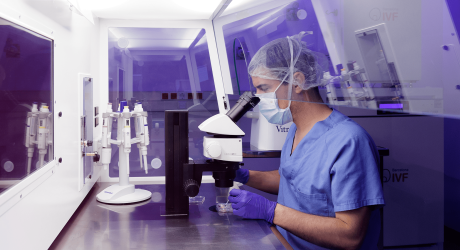

Non-invasive pre-implantation genetic testing for aneuploidies (niPGT-A) analyses the DNA that the embryo releases into the culture medium during its development to obtain information about its chromosomal characteristics, thereby allowing genetic information to be obtained from the embryo without the need for a biopsy.
This approach could become an alternative to pre-implantation genetic diagnosis (PGD), which detects genetic abnormalities in embryos prior to transfer using an embryo biopsy.
The development of niPGT-A therefore aims to obtain genetic information whilst minimising manipulation of the embryo. However, this technology is still undergoing research and validation and does not currently replace conventional genetic analysis via biopsy.
How does genetic analysis of the embryo without a biopsy work?
During its development in the laboratory, the embryo releases small amounts of DNA into the culture medium. niPGT-A analyses this material to obtain information about the embryo’s chromosomes without the need to extract cells from it.
Tests such as EMBRACE use this information to estimate the probability that the embryos are chromosomally normal and, in this way, help to prioritise them for transfer.
What are the advantages and limitations of non-invasive genetic analysis of embryos?
The main advantage of niPGT-A is that it provides genetic information without the need for an embryo biopsy, which reduces handling of the embryo and simplifies the procedure.
However, its main limitation lies in determining to what extent the DNA present in the culture medium accurately reflects the embryo’s chromosomal characteristics.
Although the results obtained so far are promising, this technology remains under investigation and validation. Consequently, niPGT-A does not currently replace conventional genetic analysis via biopsy.
Towards increasingly less invasive embryo analysis
The development of niPGT-A represents one of the current lines of research in assisted reproduction. Its aim is to obtain ever more information about the embryo whilst minimising the need for manipulation.
For these techniques to be more widely incorporated into clinical practice, it will be necessary to continue assessing their accuracy and usefulness for embryo selection.
At Barcelona IVF, we closely monitor scientific advances that can help improve treatments and decision-making, always prioritising the needs of our patients.
Frequently Asked Questions
Does niPGT-A analyse the embryo directly?
No. The analysis is carried out using the cell-free DNA that the embryo releases into the culture medium during its development, so it is not necessary to extract cells via a biopsy.
Does non-invasive genetic testing replace conventional PGT-A?
Not at present. niPGT-A can provide information to help prioritise embryos based on their likelihood of being chromosomally normal, but there are still limitations regarding its accuracy and agreement with biopsy-based analysis.
Does niPGT-A allow us to know with certainty whether an embryo is chromosomally normal?
No. The results allow for an estimate to be made and help to prioritise embryos, but they do not provide the same information as a genetic diagnosis based on a sample obtained via biopsy.