
Embryo selection is one of the most important and complex processes in in vitro fertilisation (IVF) treatment. The decision to transfer, vitrify or discard an embryo combines the expertise of embryologists, scientific criteria and advanced technology to identify those embryos with the greatest potential for implantation and developmental capacity.
How is an embryo assessed?
From the moment of fertilisation, the embryo's development is continuously monitored in the laboratory. In this way, embryologists can analyse various parameters and characteristics to determine the quality of the embryos.
Among the main criteria assessed are:
- The number of cells.
- The symmetry between them.
- The degree of cell fragmentation.
- The presence of abnormalities, such as multinucleation.
When the embryo reaches the blastocyst stage, usually on day 5 or 6 of development, more complex structures are also assessed, such as:
- The inner cell mass, which will give rise to the future baby.
- The trophoectoderm, responsible for forming the placenta.
- The degree of blastocyst expansion.
All this information allows embryos to be classified according to their quality and their chances of implantation to be estimated.
Beyond morphology: the importance of development time
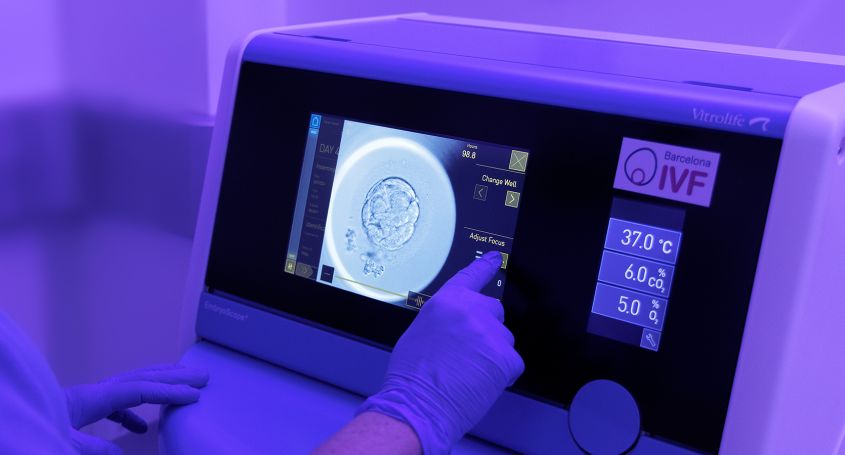
In recent years, embryo assessment has evolved thanks to the incorporation of advanced technologies such as time-lapse systems, like the EmbryoScope, which allow embryonic development to be monitored continuously without the need to remove the embryos from the incubator.
Thanks to this information, embryologists can detect developmental patterns associated with a higher or lower probability of implantation.
Furthermore, the incorporation of artificial intelligence tools such as iDAScore also helps to complement embryo selection through the automated analysis of images obtained using time-lapse systems.
Which embryos are transferred, vitrified or discarded?
Embryos with a higher probability of implantation are usually prioritized for embryo transfer, although the decision does not depend solely on their morphological quality. Other important factors also influence embryo selection, such as the patient's age, reproductive history, the number of available embryos, or the medical strategy of the treatment.
Viable embryos that are not transferred can be preserved using vitrification, an ultra-rapid freezing technique that allows them to be stored for future attempts.
However, not all embryos develop correctly. Sometimes, an embryo may appear healthy but still be deemed unsuitable for transfer or freezing. This is because embryo assessment is not based solely on a single image, but also on factors such as its rate of development, cell division pattern, or any abnormalities detected during culture.
The importance of a comprehensive embryo assessment
Embryo selection is a highly specialised process aimed at identifying the embryos most likely to implant and develop successfully.
At Barcelona IVF, we combine the expertise of our team of embryologists with the most advanced monitoring and analysis technologies, which help us to analyse embryo development precisely and on an individual basis.